The law of challenge in peacetime
The Horse and His BoyThe law of challenge in peacetime is the principle that an attack on a castle during peace, without first issuing a challenge, forfeits the attacker’s claim to be treated as an honorable opponent. When Rabadash attacks Anvard without warning, King Lune cites this rule to refuse him a duel and classify him as a traitor; the law turns a military violation into a judgment about political and personal honor.
The Rule and Its Breach
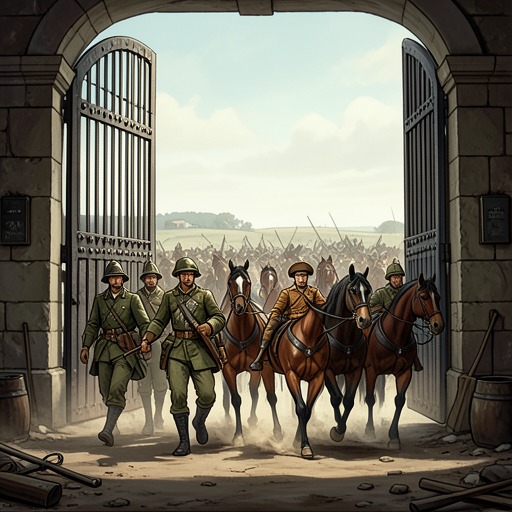
Rabadash’s plan depends on surprise. He proposes to cross the desert with two hundred horsemen, reach Anvard while Archenland is unprepared, and seize the castle before its defenders can respond. He describes the neighboring kingdom as being at peace with Calormen, yet intends to exploit that very peace to make a sudden assault possible.
After the attack, Rabadash demands that King Edmund release him so he can fight as a king and man, or kill him. King Lune refuses. He explains that, had Rabadash issued the challenge a week earlier, no one in Edmund’s dominion—from the High King to the smallest Talking Mouse—would have refused it. By attacking Anvard in peacetime without a challenge, however, Rabadash has shown himself to be no knight but a traitor. Lune orders him bound and taken into the castle rather than granting him a duel.
Legal Judgment and Consequences
The rule determines how Rabadash is treated after his defeat. His demand for combat cannot erase the circumstances of his attack: the issue is not whether he is willing to fight now, but that he chose to strike a castle during peace without giving its defenders the chance to answer a challenge. Lune therefore rejects the duel as an honor Rabadash has forfeited and orders him detained.
The distinction remains central when Lune later considers releasing the prisoner. He says that the law of nations and prudent policy would give them as good a right to Rabadash’s head as one person could claim against another. Nevertheless, Lune is prepared to set him free unharmed on conditions, citing his youth and poor upbringing. The offer is a possible act of clemency, not a denial that the attack has legal consequences; Rabadash interrupts before Lune can finish stating the conditions.
Honor, Law, and Political Authority
The law contrasts Rabadash’s conduct with the kind of conflict he later claims to want. He calls for a personal fight after being captured, but Lune points out that this belated demand cannot make his earlier surprise attack honorable. The timing and manner of the violence matter: a challenge would have allowed an answer, whereas the assault exploited the absence of preparation.
The episode also places limits on royal power. In the later discussion of succession, King Lune explains that the crown passes according to law and that a king is himself under the law. That principle echoes the judgment of Rabadash: authority and rank do not exempt a prince from the rules governing his conduct. The law of challenge thus serves both as a standard of honorable warfare and as a restraint on the powerful.